







Horsehair Hitching |
|
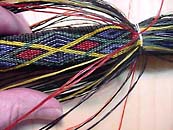
Hitching is begun by twisting tail hairs together to create what are called
pulls. Sometimes they are called twists, strings or strands, but for this
discussion we'll call them pulls. The pulls are knotted over a string using open
or closed half hitches. This is where the name hitching comes from. These half
hitches are done over a string that is wrapped around a dowel. As the
knots are made the pattern works its way around the dowel in a continuous
circle. The
pattern builds as the string goes around the dowel. The pattern is determined by
open or closed hitches as well as adding and dropping pulls. Different colors
can be added to make interesting patterns. Once you understand the rules that
make up a pattern. You're only limited by your imagination.
The process of
hitching is very time consuming and thus the hitched items that are produced are
naturally quite expensive. Horsehair hitching can not be mass produced, so a
one of kind piece can be well worth the price. Hitched items such as hat bands
and bridles often incorporate some braiding.
|
|
What do you hitch with?
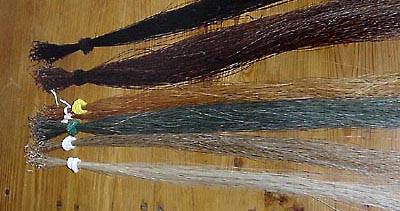
The material used in horsehair hitching is mainly tail hair from the horse. Tail hair is approximately 24 to 30 inches long. The individual strands are twisted together to make pulls, which are used for hitching.
|
|
How many strands of horsehair are used in a pull?
Different hitchers prefer to work with different size pulls. The average is 8 to 12 stands of hair per pull. The different amount of strands will determine the fineness of the hitching. Less strands per pull will make a finer final piece. You rarely hear of hitchers using more than 12 strands per pull.
Where do you get the horsehair?
A small amount of hair, approximately the width of one or two fingers can be cut
from the underside of a horses tail and never be noticed. A lot of hitchers are
given hair from people that want an item made from their horses tail. It is a
very personal item to own. If you are interested in collecting your own
horsehair for a project go to my page on collecting
horsehair.
Horsehair can also be purchased through distributors. There are a few listed
on the Links page.

E-mail [email protected]
Marjan Polek
1042 Willow Creek Rd. A101-516
Prescott, Arizona 86301